
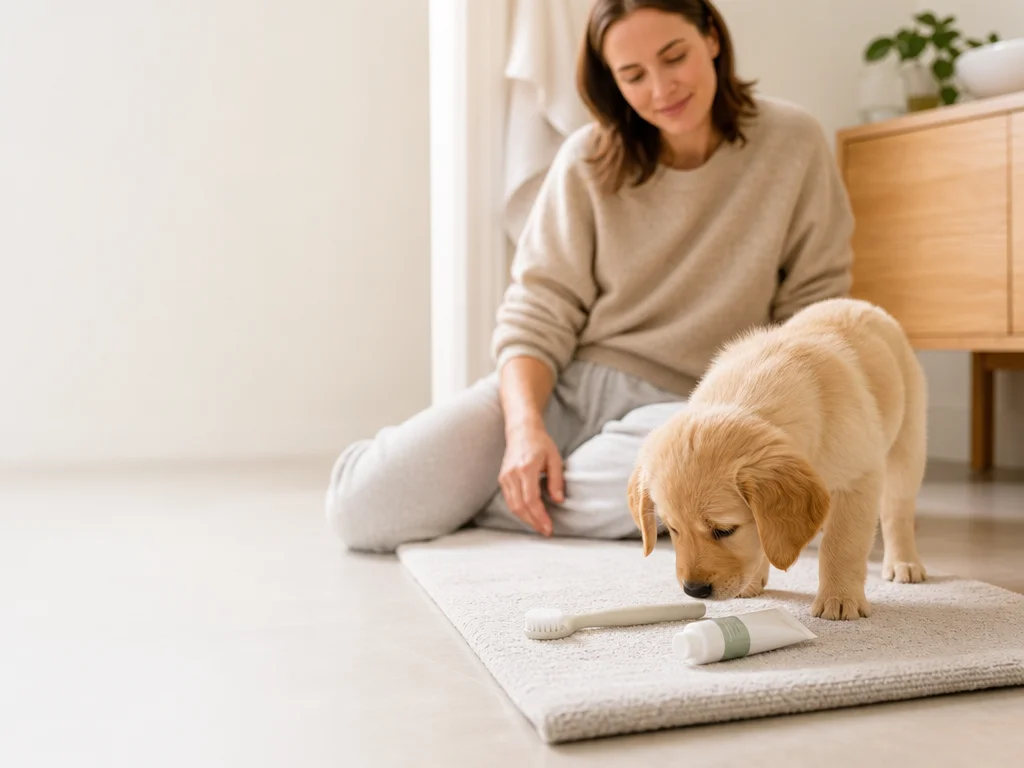
Start with willingness, not a full mouth of brushing
Tooth brushing is most useful when a puppy learns that the toothbrush, toothpaste, and gentle handling predict good things. It is not a test of whether you can hold a tiny mouth open. A puppy who chooses to stay near the brush, takes a treat, and remains relaxed is learning a skill that can support everyday oral care throughout life.
The American Veterinary Medical Association describes regular brushing as the most effective home step for keeping a pet’s teeth healthy between professional dental cleanings. Daily brushing is ideal when practical, but the same AVMA guidance says several times a week can be helpful. For a new puppy, however, the first goal is comfort. A few seconds of easy practice is a stronger foundation than a long session that makes the brush scary.
This is a guide to gentle home learning, not a way to assess or fix a mouth problem. If you see signs of pain or illness, skip practice and contact a veterinarian. Brushing does not replace veterinary examinations or professional dental care.
Gather only the basics
You need a soft toothbrush made for dogs, a finger brush only if your puppy comfortably accepts it, dog-safe toothpaste, a few tiny treats, and a quiet place at floor level. Pick a time when your puppy is awake but not bursting with play energy. Sit beside them rather than leaning over their head, and keep the tools visible but unimportant.
Use only toothpaste formulated for dogs. Human toothpaste is not a substitute and should not be used for a puppy. Do not assume that a flavored product, chew, water additive, or dental diet is appropriate simply because it is sold for pets. Ask your veterinarian what fits your puppy, and use products exactly as directed. The Veterinary Oral Health Council maintains a list of products that have earned its Seal of Acceptance for specific plaque or tartar claims; that list can be a starting point for a veterinarian conversation, not a replacement for it.
Keep the brush clean, replace it when worn, and store toothpaste where your puppy cannot help themselves. Avoid improvised powders, human mouthwash, or home mixtures. Your puppy does not need every dental product at once. One safe brush, one dog-safe toothpaste, and short cooperative practice are enough to begin.
Teach the pieces in separate, tiny sessions
Break the routine into steps your puppy can understand. You may stay on one step for several sessions. If your puppy walks away, stops taking treats, turns their head, freezes, licks their lips repeatedly, growls, or tries to avoid your hand, stop. Those signals mean the current version is too difficult, not that your puppy needs firmer handling.
- Let the toothbrush appear. Place it on the floor or hold it quietly at a distance. Reward your puppy for looking at or sniffing it, then put it away.
- Introduce the toothpaste separately. Offer a tiny amount of dog-safe toothpaste on your finger or the brush only if the label allows it. Let the puppy investigate; do not smear it into their mouth.
- Practice a gentle face touch. Briefly touch the outside of the cheek, give a treat, and remove your hand. Repeat only while your puppy stays loose and interested.
- Lift the lip for a moment. On a later session, lift one side of the lip just enough to see an outer tooth, reward, and stop. There is no need to pry the mouth open.
- Make one soft brush stroke. Touch an outside tooth near the cheek with light pressure, reward, then take the brush away. One stroke is a complete first brushing lesson.
- Add gradually. Over days or weeks, add a few strokes on the outer surfaces your puppy accepts. Keep sessions short and end before patience runs out.
The VOHC brushing guidance notes that the cheek-facing surfaces of upper teeth are a useful focus, and that some pets will not tolerate a full brushing sequence. That is normal. Regular, comfortable activity is better than a struggle for perfect coverage.
Make the routine easy to repeat
Attach brushing practice to an ordinary cue in your day, such as after a calm evening toilet break or before settling with a favorite chew that your veterinarian has approved. The cue is for you, not a demand placed on the puppy. If today is busy or your puppy is tired, skip it and resume with an easy step tomorrow.
Use rewards that work for your puppy: a tiny treat, soft praise, or access to a favorite quiet activity. Keep food rewards small enough that they do not become the main event. The important association is that seeing the brush and accepting one gentle action leads to something pleasant and then a break.
Avoid cornering your puppy, wrapping them tightly in a towel, holding the muzzle shut, or using another person to restrain them. Those shortcuts can make future handling harder and create a bite risk. If you need help with the setup, ask your veterinary team to demonstrate a calm approach at an appointment. A qualified reward-based behavior professional can also help with cooperative-care training after a veterinarian has ruled out a physical concern.
What brushing can and cannot do
Brushing is home care, not diagnosis, scaling, tooth removal, or treatment. You may see plaque or tartar, but do not scrape at teeth with tools or attempt to remove buildup yourself. Veterinary teams use appropriate assessment and professional procedures when those are needed. An awake look at a puppy’s mouth cannot tell you everything about dental health.
Dental chews, diets, wipes, and water additives are not automatic replacements for brushing. Some products have evidence for particular uses, and others may not fit a given puppy’s diet, size, chewing style, or health needs. The VOHC recommends periodic veterinary examination of the mouth and teeth. Ask your veterinarian before choosing an add-on product, and supervise any chew your puppy receives.
For a teething puppy, a little extra chewing or temporary sensitivity can make mouth handling less welcome. Keep sessions especially easy rather than pushing ahead. If brushing that was comfortable suddenly becomes difficult, that change is useful information to share with a veterinarian.
When to get professional help
Contact your veterinarian promptly if you notice pain when eating or touched around the mouth, facial swelling, bleeding, persistent bad breath, a broken tooth, discharge, a new lump, drooling that concerns you, or a sudden refusal to let you near the mouth. Do not try to brush through those signs, diagnose the cause, or use home products to treat them. A veterinary professional can decide what assessment and care are appropriate.
Also ask for help if your puppy consistently panics, growls, snaps, or cannot be handled safely during practice. Stop the session and explain exactly what you observed. Your veterinarian can advise whether an examination, a staged home plan, or referral to a qualified reward-based behavior professional is the next safe step. A calm pause protects trust; it is not a failure.
Sources and further reading
- American Veterinary Medical Association: What can I do at home for my pet's oral health? — veterinary guidance on regular brushing and professional dental care.
- Veterinary Oral Health Council: Brushing — guidance on brushing technique, regularity, and veterinary involvement.
- Veterinary Oral Health Council: Accepted Products — product categories evaluated for the VOHC Seal of Acceptance.
- VCA Animal Hospitals: Brushing Your Dog's Teeth — veterinary overview of dog tooth-brushing at home.
keep learning with Pawaily ♡
Get practical pet guidance
Short, evidence-informed ideas for learning, health, grooming, nutrition, and everyday care.