
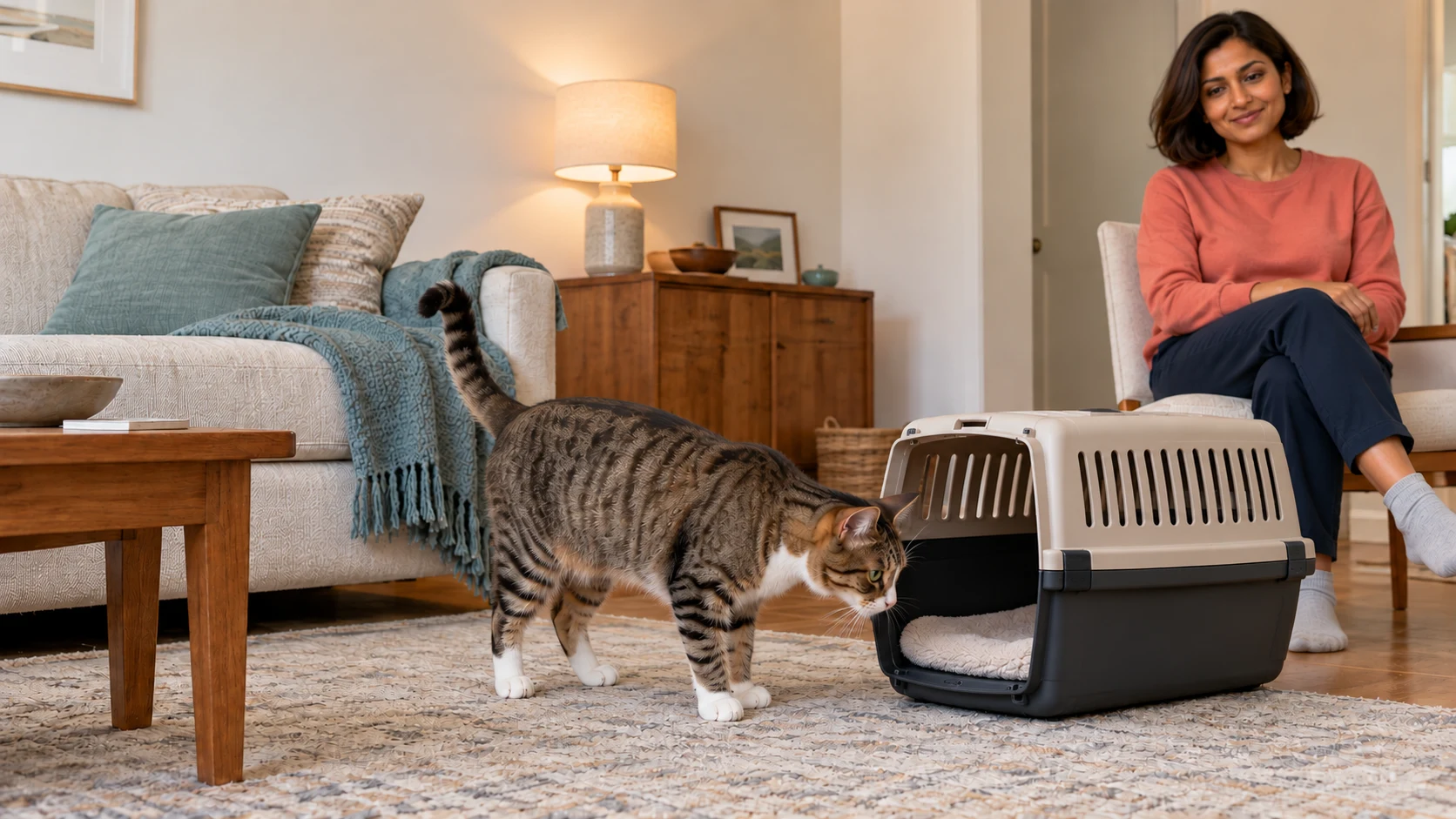
You can learn something useful about your cat through one small, voluntary experience. Begin with what they choose, keep the setup manageable, and leave room to stop.
Set up before you invite
Use an intact carrier large enough for your cat to turn and lie comfortably. Set it on the floor in a quiet familiar place. Secure the door fully open or remove it as the maker allows, so it cannot swing shut. Put familiar bedding nearby; if your cat already approaches freely, it can go inside.
Keep the route clear. If the carrier itself worries your cat, start with bedding farther away and let them choose the distance. This is a quiet practice step, not preparation for an immediate forced trip.
Reward where your cat is comfortable
Sit back and let your cat notice the setup. Place a small familiar treat on the bedding or near the carrier at a distance they already choose. Keep hands away and wait quietly for a minute. A look, sniff or step toward it can be enough. Let them leave at any time.
Use food that suits your cat’s usual diet and veterinary advice. If they do not approach or eat, make the next setup easier or finish. Do not move the food deeper to draw a hesitant cat inside.
Keep the promise of an open exit
If your cat explores comfortably, you may leave another treat at the same easy spot. If they back away, crouch tensely or stop engaging, end and give space. Keep the door open throughout; no closing, lifting or carrying today. Note the distance or action they chose.
You created an option without taking away choice. Repeat an easy step another day and progress only with a gradual plan. If travel is soon or your cat is distressed, call your clinic for help. Never delay urgent veterinary care to finish training.
Begin when there is no trip to complete
If the carrier usually appears shortly before a journey, it can be difficult to make the first practice moment feel unhurried. Choose an ordinary quiet time, with no immediate departure to manage. This guide covers one early step: making an open carrier available and allowing voluntary exploration. It does not show that a cat is ready for a closed door, lifting or travel.
The useful outcome might be very small. Your cat may stay in the room, look towards the setup or approach bedding placed at a comfortable distance. Those observations can help you decide how to make the next invitation easier. They are not a pass or fail score, and they do not tell you everything about the cat's feelings. Leave room for a different response another day.
Make the equipment part of a comfortable space
Start by checking the carrier itself. Follow its maker's instructions, inspect the door and fastenings, and make sure it is suitable for your cat. Place it securely on the floor rather than on a raised surface where it could fall. The open door must not swing into the cat's route or close unexpectedly. If it can be removed safely according to the instructions, that may simplify this early setup.
Choose a quiet, familiar area with an unobstructed exit. Keep other animals from crowding the opening. Familiar bedding can begin outside the carrier if approaching the carrier is already difficult. You do not need to place the cat on that bedding. Let them decide whether to come closer. If they avoid the area, increase the distance or end the practice rather than following them with the equipment.
Food supports a choice rather than setting a trap
If you use food, choose a small familiar treat that fits your cat's usual diet and any veterinary advice. Offer it where your cat already feels able to approach. Keep your hands out of the doorway and wait without leaning over them. Eating near the carrier is one observation; refusing food is a reason to make the setup easier or finish, rather than withhold meals.
Avoid moving a treat deeper inside to draw a hesitant cat farther than they would otherwise choose. Do not close the door after they follow food. For this practice, the exit remains open throughout. That clear boundary helps you keep the task small. If your cat walks inside freely, you can still stop at the same open-door step instead of taking the opportunity to lift or carry them.
Keep descriptions close to what happened
“Sniffed the bedding beside the door” is a useful description. “Finally trusts the carrier completely” goes beyond what a brief observation can establish. Notice the distance your cat chose, whether they stayed nearby and whether they were able to leave. If they back away or crouch tensely, give space. You do not need to wait until there is a stronger reaction before ending.
After an easy experience, repeat a comfortable step on another occasion. A more complete carrier plan involves gradual changes and may need support from your veterinary team. There is no promised number of days. Your cat's earlier experiences and current needs may affect how you proceed. A household deadline is not a reason to move through several steps in a single practice period.
Practice and necessary veterinary care are different situations
The carrier will still be needed for real journeys. An open-door exercise does not replace secure, appropriate transport, and this article is not an emergency loading technique. If an appointment is soon and your cat struggles with the carrier, call the clinic ahead of time. Explain what happens so they can advise on an appropriate plan for that individual and journey.
Never postpone urgent veterinary care until training is complete. Equally, avoid improvising restraint or medication based on a general article. Ask the clinic how to proceed. Between necessary trips, quiet voluntary practice can remain a separate activity, with no requirement to shut the door at the end. Keeping that distinction clear lets you offer manageable learning while still responding promptly when your cat needs professional care.
When to get professional help
Contact your clinic if your cat is distressed around the carrier, if travel is approaching or if you cannot manage transport safely. Seek prompt veterinary advice for pain, injury or sudden behavior changes. Do not delay urgent care to finish this exercise, and do not give medication without individual veterinary instructions.
The takeaway: make one safe invitation, notice what your cat chooses, and build from that information at their pace.
keep learning with Pawaily ♡
Get practical pet guidance
Explore kind, practical learning and everyday discoveries with Pawaily.
Create account