
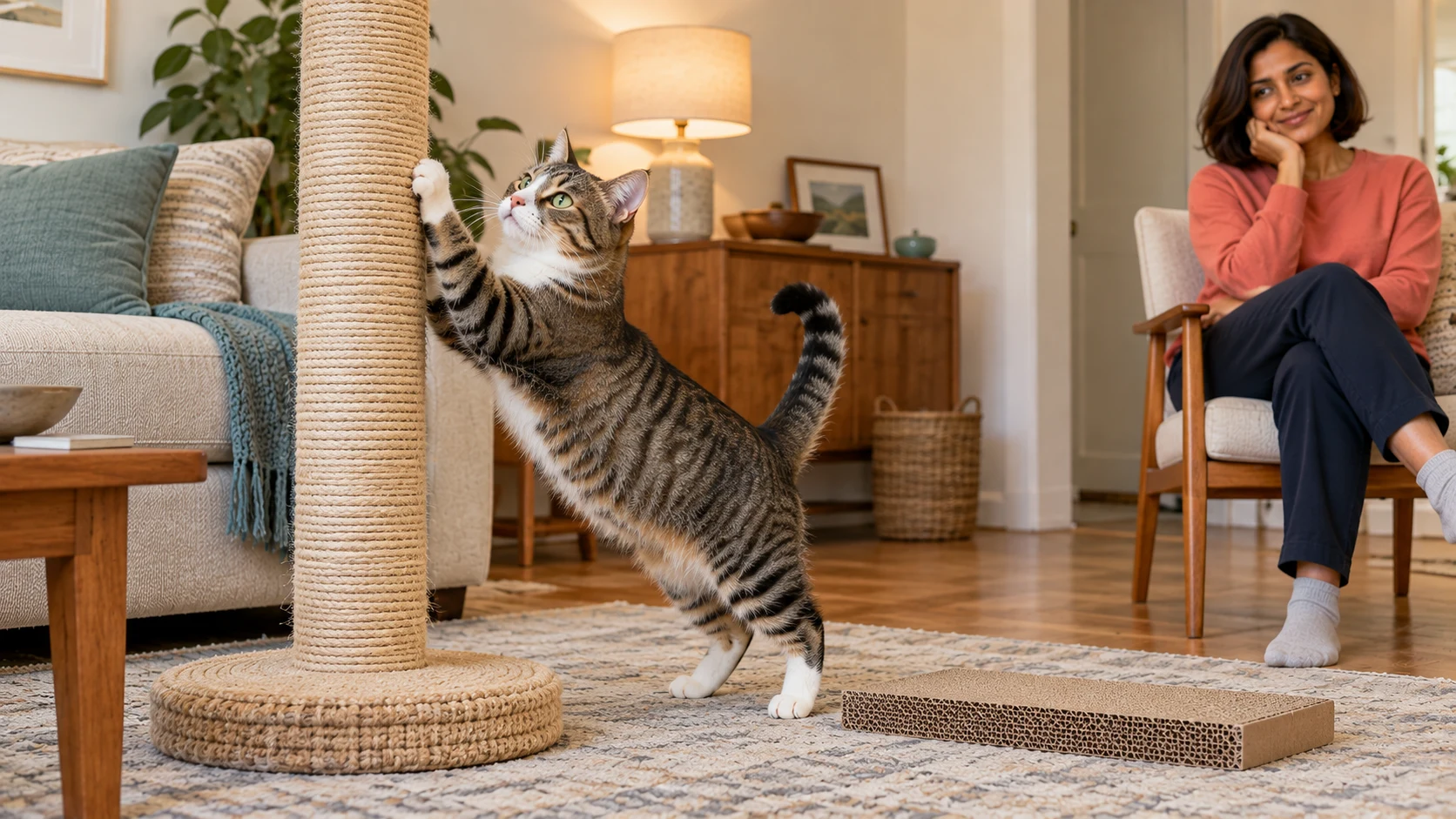
You can learn something useful about your cat through one small, voluntary experience. Begin with what they choose, keep the setup manageable, and leave room to stop.
Start with what your cat chooses
Scratching is a normal need. Look at an existing scratch mark or recall a recent scratch: was your cat reaching up, or scratching along the floor? Notice the surface too. Spend a minute looking without asking your cat to perform. If you do not know yet, keep that as your starting note.
A cat who chooses a rug may need a flat scratcher; a cat who reaches up may prefer a tall one. These are clues to try, not a rule every cat follows.
Make one safe place available
Choose an intact scratcher suited to that clue. A vertical post needs a heavy base and enough height for a full stretch. A flat board must stay still under paws. With your cat elsewhere, check it will not slide or tip. Put it beside an already chosen scratching spot, without narrowing a walkway.
Keep any familiar scratchers. Do not place your cat on the new one or rub their paws against it. Leave room for them to inspect it or walk past.
Watch without making it a test
Step back and watch quietly for about a minute if your cat is nearby. They may scratch, sniff, pass by or do nothing. If they choose to scratch, offer calm praise if they enjoy it. If they avoid it, leave them be and check its position, surface and stability later.
You made a useful choice by making space for a normal need. Keep one true note: what surface was offered, where it stood, and what you saw. A visit with no scratching still gives you a starting point.
A normal need with an individual preference
Finding a scratch on a chair can be frustrating. Begin by treating the mark as information about an ordinary feline behavior. The immediate question is where and how your cat can scratch comfortably. You do not need to decide that they are being difficult, or make them demonstrate the behavior again for you to learn something useful.
A horizontal mark and a vertical mark can suggest different starting options. The surface and location may matter too. These clues help you choose what to offer; they do not establish a fixed preference or explain every reason for scratching. One cat may use more than one kind of surface. A new board also does not automatically meet needs associated with worry or conflict elsewhere in the home.
Observe the place before buying more things
Look at the position of the existing mark when your cat is elsewhere. Is it beside a resting place, at the edge of a room or on an object that stays firmly in place? Describe those details before changing the area. A clear observation is more helpful than buying several objects and placing them in locations your cat never chooses to visit.
For example, a cat who scratches a rug might be offered a stable flat board nearby. A cat who stretches up against a sofa might be offered a tall, stable post beside that spot. These are examples of matching an available outlet to an observed action. They are not instructions to move your cat onto the new surface, handle their paws or insist on a particular posture.
Stability comes before encouragement
A scratcher should stay secure under the kind of use it is designed for. Check the manufacturer's setup instructions and test its stability while your cat is away. A tall post needs a suitable base and enough height to allow a full stretch. A flat board needs to stay still rather than slide away under paws. Replace or repair unsuitable equipment before offering it.
Keep the surrounding route usable. A new object should not make another pet, a doorway or a narrow corridor harder to pass. Leave familiar scratching options available while you introduce the new one. There is no need to remove a well-used post simply because a newer one looks tidier to you. Your first change can be small: one suitable option beside an already chosen spot.
An ordinary observation is enough
After setup, step back. If your cat is nearby, you can watch quietly for a short period. They may sniff the new surface, scratch it, walk around it or leave. Do not turn waiting into pressure by repeatedly calling them over. A calm approach today does not guarantee use tomorrow; passing it today does not prove the setup will never be useful.
If they choose to scratch, offer quiet praise if that is something they enjoy. Avoid sudden excitement that interrupts the moment. If they leave, allow that choice. Later, check whether the surface, height and location still fit the clues you noticed. Adjusting one detail at a time can make it easier to understand which setup your cat actually uses.
Protect the relationship while you adjust the space
You can look after furniture while still providing an appropriate scratching outlet. Choose any protective covering carefully so it does not introduce loose pieces or other hazards. The useful long-term question remains whether your cat has a stable and accessible place to scratch. Punishment and forcing paws onto a post do not belong in this activity.
You might remember the location, material and observed response in one plain sentence. That is enough for a starting point. A home with more than one cat needs attention to each individual's access to resources; one new post is not a complete answer to conflict. If scratching changes sharply or appears alongside distress, seek help rather than continually replacing equipment and hoping the concern will disappear.
When to get professional help
Ask your veterinarian about pain, injury, mobility changes or a sudden change in behavior. If scratching seems connected with ongoing fear or conflict, seek veterinary advice and support from a qualified cat behavior professional. A scratching post alone may not resolve an underlying welfare concern. Do not punish your cat for communicating a need.
The takeaway: make one safe invitation, notice what your cat chooses, and build from that information at their pace.
keep learning with Pawaily ♡
Get practical pet guidance
Explore kind, practical learning and everyday discoveries with Pawaily.
Create account