
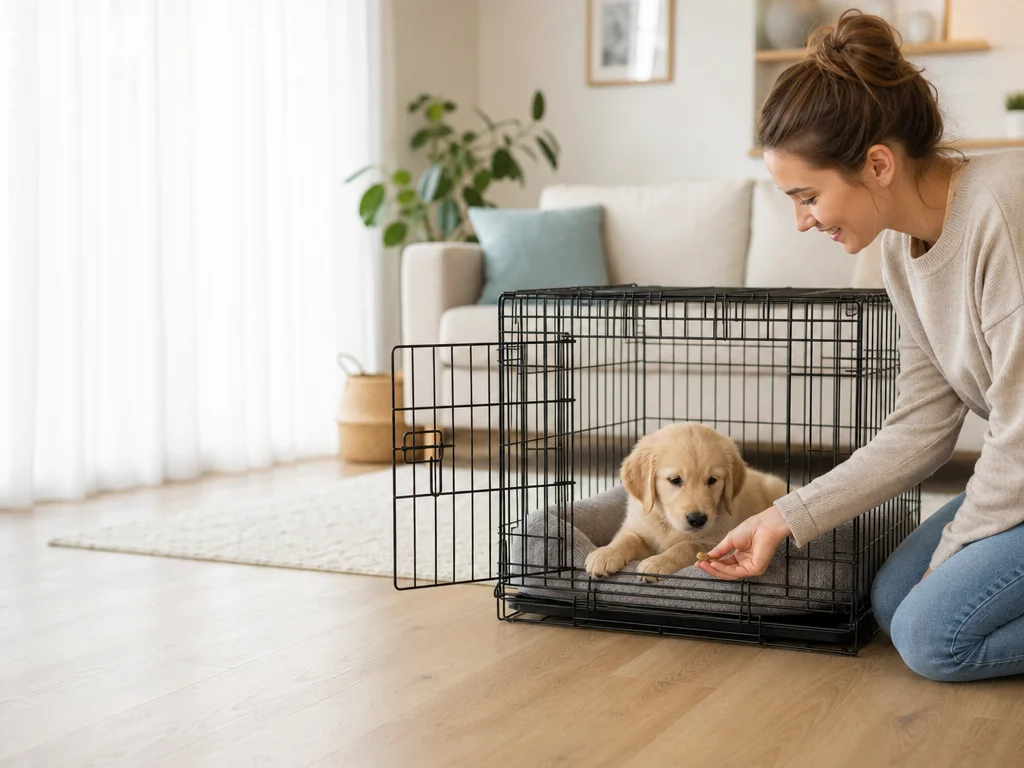
The short answer
Crate training is the gradual process of helping a puppy feel comfortable entering, resting in, and eventually spending short calm periods inside a crate. It can be useful for travel, veterinary care, quiet rest, and short-term management, but it is not required for every puppy or every home. A crate is most helpful when it becomes a safe, predictable place—not a punishment, a storage space, or a solution for distress.
Begin with an open door and an easy choice. Put the crate in a quiet, practical place where your puppy can be near household life without being constantly handled. The UC Davis crate-training guide recommends letting a puppy discover treats and toys in a comfortable crate, then building closed-door time slowly only after the puppy is relaxed inside.
Start here: Secure the door so it cannot swing and startle your puppy. Place a few treats near the entrance, then let your puppy investigate without pushing or placing them inside.
Choose a safe resting space
Your puppy should be able to stand, turn around, and lie down comfortably. A crate that is too small can be uncomfortable; one that gives a very young puppy a separate toilet corner may make house training harder. If you expect your puppy to grow considerably, ask a knowledgeable professional about an appropriate setup and divider.
Place the crate on a stable surface away from drafts, direct heat, wires, and objects a puppy can pull through the sides. Bedding can be comfortable for some puppies, but choose materials that are safe for your individual dog. A puppy who chews or swallows fabric needs a different setup from one who rests quietly on a mat. Keep water, chew items, and toys appropriate to your puppy's age and supervision needs.
The crate is only one option for safe rest. A gated puppy-proof room, pen, or other prepared area may suit some homes better. The important question is whether your puppy can be safe and comfortable there, not whether the space looks like someone else's setup.
Let your puppy choose to enter
Start with the door secured open. Drop a treat near the entrance, then just inside, and let your puppy decide whether to follow it. If they take a treat and immediately leave, that is still useful information: the crate can be entered and exited safely. Do not close the door just because the puppy stepped inside for the first time.
You can feed a meal near the crate, then just inside it if your puppy is comfortable. VCA's crate-training guidance similarly describes encouraging voluntary entry with food, toys, and a calm introduction. If a puppy refuses food, avoids the area, freezes, or repeatedly tries to leave, make the next step easier. The crate may need to be moved, the session may be too long, or the puppy may need more time to feel safe.
Avoid carrying, shoving, or luring a reluctant puppy so far inside that they cannot choose to leave. A treat is helpful only when it supports a comfortable choice, not when it masks distress.
Add a closed door in tiny steps
After your puppy is relaxed while entering and resting with the door open, briefly touch the door, reward, and open it again. Next, close it for a second while your puppy eats or rests, then open it before they become concerned. Stay nearby and keep your body language ordinary.
Increase only when the previous step is easy. You might add a few more seconds with the door closed, sit a little farther away, or briefly stand up and sit down again. Change one part of the picture at a time. A puppy who can rest with a closed door while you sit beside the crate is not automatically ready for you to leave the room.
If your puppy begins to pace, pant, scratch frantically, refuse food, try to escape, or become increasingly upset, do not keep extending the time in hopes that they will “get used to it.” End the next practice earlier and return to a step where the puppy can remain comfortable. The goal is a history of calm repetitions, not silence at any cost.
Make rest predictable, not punitive
Offer the crate during quiet moments as well as when you need practical help. A puppy who only enters the crate when people leave, visitors arrive, or they have done something unwanted may learn that it predicts isolation or loss of fun. A treat tossed into the open crate, a calm chew under supervision, or a short voluntary nap can help the space stay neutral or pleasant.
Do not use the crate for punishment. The AVSAB humane dog training statement recommends reward-based rather than aversive training methods. If a puppy has made a mistake, clean up, manage the environment, and set up the next moment for success instead of sending them to the crate.
For a new puppy, toilet needs, food, water, activity, health, age, and prior experience all affect what is realistic. A crate does not remove the need for toilet opportunities, play, care, and supervision. Your puppy's first week at home explains how rest, toilet trips, and a smaller prepared space can work together in those early days.
Crate comfort is not the same as alone time
Some puppies enjoy a crate while a person is nearby but become worried when left alone. Others prefer resting outside a crate but can learn brief, comfortable separations in another safe space. Do not assume that closing a crate door teaches independence by itself.
If alone time is the goal, begin with the puppy's basic needs met and build tiny, successful absences. Our guide to teaching a puppy to be alone explains why comfort with a safe space and comfort with a person leaving are related but different learning projects.
Nighttime crying can also have more than one cause: a puppy may need a toilet opportunity, be scared, be uncomfortable, or need a slower crate introduction. Read Puppy crying in the crate at night? for calm checks and signs that the situation needs more support.
What progress can look like
Progress can be a puppy who walks in to collect a treat, lies down with the door open, stays relaxed for a few seconds with the door closed, or chooses the crate as a place to rest. It is not a fixed timeline and it does not need to happen in one long session. A slower, willing introduction is usually more useful than a fast one that makes the crate feel alarming.
If your puppy has already had a difficult experience with confinement, it may take more care to rebuild comfort. Start with the easiest possible version: seeing the crate from a distance, hearing the door move, or taking a treat beside it. Do not make progress by trapping the puppy inside their fear.
When to get professional help
Contact a vet promptly if crate distress is sudden, comes with signs of pain or illness, includes self-injury, repeated vomiting, heavy drooling, breathing difficulty, or a marked change in appetite or energy. A physical problem can affect a puppy's ability to rest comfortably.
Ask a vet or qualified reward-based behaviour professional for help if your puppy panics with confinement, repeatedly damages the crate or barriers, cannot tolerate even very easy steps, or if you are concerned about safety. Do not leave a puppy to struggle through escalating distress because an online rule says they “must learn.”
Sources and further reading
- UC Davis: Crate training your puppy — positive crate introduction, size, and gradual comfort.
- VCA: How to crate train your dog — voluntary entry and short, calm steps.
- AVSAB: Humane dog training position statement — evidence-based reward training guidance.
keep learning with Pawaily ♡
Get practical pet guidance
Short, evidence-informed ideas for learning, health, grooming, nutrition, and everyday care.