
The short answer
Do not automatically ignore every cry. A new puppy may vocalize because they need the toilet, feel frightened in an unfamiliar home, are uncomfortable, or have been asked to stay alone longer than they can manage. A few soft sounds that fade while the puppy remains physically relaxed are different from crying that becomes louder, frantic, or accompanied by attempts to escape.
Check what your puppy needs, keep the interaction calm, and help them feel safe enough to settle. Responding to distress does not spoil a puppy, and a quiet practical check need not become an exciting play session.
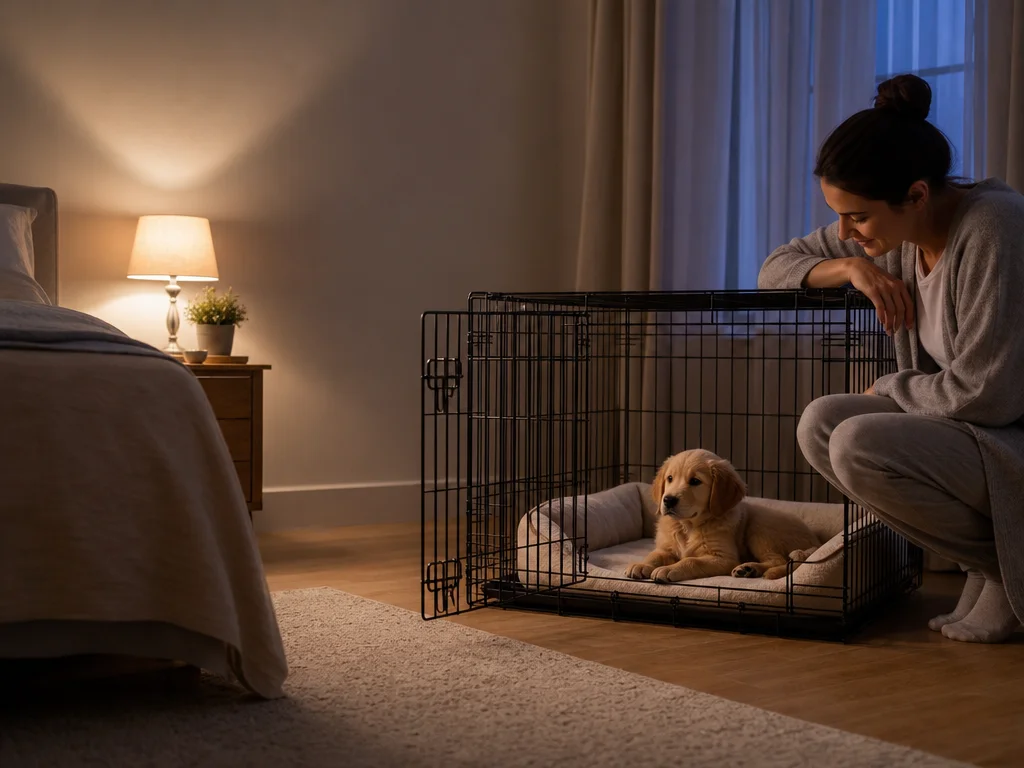
Try this first: Keep your puppy’s sleeping space near you, make sure they have had a calm toilet opportunity, and listen for whether the crying softens or escalates. If you need to respond, use the same quiet sequence each time.
Why puppies cry at night
A puppy’s first nights in a new home are a major change. They may have gone from sleeping beside their mother and littermates to resting alone among unfamiliar sounds and smells. Blue Cross notes that being alone at night can be frightening and recommends beginning with the puppy near you before gradually increasing distance.
Crying can communicate a practical need. Young puppies may need a nighttime toilet trip, feel too warm or cold, or react to household noise. Some become wild and vocal when overtired. If your puppy also becomes mouthy, our guide to puppy biting at night explains that evening pattern.
Before you respond, check the basics
- Toilet: When did your puppy last relieve themselves? A young puppy may not yet be able to wait until morning.
- Comfort: Is the area dry, comfortably cool, and large enough for the puppy to stand, turn, stretch, and lie down?
- Safety: Remove anything that could catch on the crate and use only items that are safe without close supervision.
- Proximity: A new puppy may cope better with a crate, pen, or bed beside you than in a distant room.
- Health: Sudden or unusual crying can accompany pain, stomach upset, urinary discomfort, breathing trouble, or another medical problem.
Fresh water should remain available in a suitable non-spill container. Trying to prevent waking by restricting water can create a welfare or health problem and does not teach comfortable nighttime settling.
A calm response you can use tonight
1. Listen before assuming
Pause and observe. A few quiet whines while shifting position differ from panting, trembling, biting the bars, or frantic escape attempts. The behavior around the sound matters more than a stopwatch.
2. Check immediate needs
If a toilet break is plausible, go directly to the usual place. Keep lights and conversation low, praise quietly when your puppy relieves themselves, and return without play.
3. Help them resettle nearby
Place the sleeping area where your puppy can hear and smell you. Your presence may be enough. Dogs Trust describes starting nearby, then moving the bed gradually as the puppy becomes comfortable.
4. Make tomorrow’s practice easier
If distress begins as soon as the door closes, return to easier daytime practice. The crate should predict safety and rest, not forced isolation.
Brief protest or real distress?
There is no universal number of minutes that makes crying harmless. A puppy who makes intermittent sounds, takes food, moves normally, and begins to relax may be adjusting. Stay close enough to notice changes.
Distress may intensify rather than fade. A puppy may pant in a cool room, drool, tremble, refuse a valued treat, toilet despite a recent trip, or make frantic escape attempts. Scrabbling or biting metal can cause injury. Do not leave a panicking puppy to rehearse that experience.
When unsure, make the situation easier. Responding to genuine distress is not the same as making every small whine exciting.
Make the sleeping space easier
A crate is one option, not a requirement. Dogs Trust’s crate guidance recommends a slow introduction and an easier step when a puppy worries. A playpen, puppy-safe gated area, or bed beside you may work better temporarily.
Make the space comfortable before bedtime and let your puppy explore it with the door open. Reduce sudden noise and keep the evening predictable. A calm toilet trip followed by quiet settling is usually more helpful than vigorous play before sleep.
Daytime practice supports nighttime sleep
Practise when your puppy is relaxed. Drop a treat inside the open crate or pen and allow them to leave. When they choose to remain comfortably, briefly move the door and open it again. Increase duration and distance only while they stay relaxed.
The RSPCA crate guide follows the same gradual principle. Nighttime is easier when confinement is already familiar.
Common reactions to skip
Avoid scolding, striking the crate, spraying water, or using the space as punishment. Do not force a frightened puppy inside and expect exhaustion to solve the problem. Keep wake-ups boring without refusing a genuine need.
Age, health, previous experience, location, and toilet needs affect settling. A step that suited another puppy may overwhelm yours.
What improvement can look like
Your puppy may return to sleep faster, enter willingly, vocalize less intensely, or stay relaxed while you move farther away. One difficult night does not erase learning.
Once your puppy settles comfortably near you, shift the bed, pen, or crate a small distance. If crying returns, reduce the distance. Comfort gives independence a stable place to grow.
When to get professional help
Contact a veterinarian promptly for sudden crying, suspected pain, breathing difficulty, repeated vomiting or diarrhea, urinary trouble, injury, unusual weakness, or another health change. Seek urgent care for severe symptoms or immediate danger.
Ask your veterinarian for a qualified reward-based behavior referral when panic persists, your puppy repeatedly tries to escape, becomes injured, or cannot tolerate gradual practice. A professional can assess the full context.
Sources and further reading
- Blue Cross: How to get your puppy to sleep through the night — nighttime proximity, toilet needs, and gradual separation.
- Dogs Trust: First nights with a new puppy — calm routines and gradual movement of the sleeping area.
- Dogs Trust: Playpen and crate training a puppy — positive introduction, puppy comfort, and playpen alternatives.
- RSPCA: Dog crates — a step-by-step guide — gradual crate familiarization.
- PetMD: Puppy crying in the crate — veterinarian-authored guidance on mild vocalization, distress, and professional help.
keep learning with Pawaily ♡
Get practical pet guidance
Short, evidence-informed ideas for learning, health, grooming, nutrition, and everyday care.