
The short answer
Recall means coming back to you when you call. It is one of the most useful skills a dog can learn, but it is not a magic emergency button and it is not something to test around traffic, wildlife, or other hazards. The best beginning is much less dramatic: help your dog learn that hearing a familiar cue, turning toward you, and arriving close by are all safe and rewarding.
Start where your dog is already likely to succeed. A quiet room, a fenced area, or a long line attached to a well-fitted harness lets you practice without turning one missed response into a chase. The UC Davis School of Veterinary Medicine recommends beginning with the dog's name and attention in a calm environment, then increasing difficulty gradually.
Start here: Have a few small rewards ready before you call. Pick a moment when your dog is nearby, relaxed, and not deeply occupied with something else.
Recall is different from a name
A dog's name can mean, “please notice me.” A recall cue means, “come all the way back to me.” Keeping those jobs separate makes both easier to understand. If your dog does not yet turn toward you when they hear their name, begin there: say the name once in a warm voice, mark the moment they look toward you, and offer a reward.
Once that response is easy, choose one recall word your household can use consistently, such as “come” or “here.” It does not need to sound special. What matters is that everyone uses the same word and that the word is followed by good outcomes. Avoid using it as background chatter, a warning that you are angry, or a signal that the walk is definitely over.
Teach the first easy return
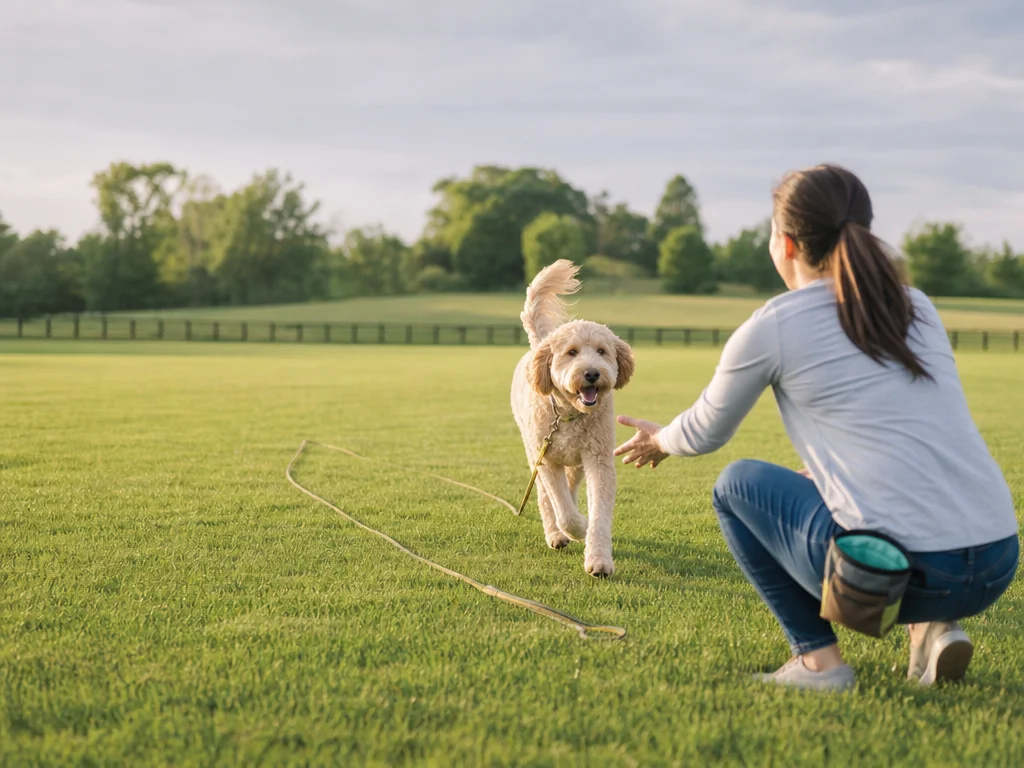
Stand a step or two away while your dog is already looking at you. Say their name, then your recall cue once. Lowering your body a little, smiling, and taking a step backward can make your invitation clearer. When your dog commits to moving toward you, praise them and give the reward when they arrive.
At first, the reward can be food, a favorite toy, access to sniffing, or another safe activity your dog values. The point is not to bargain with a visible treat every time. It is to make the completed behavior worth repeating. UC Davis advises rewarding the return promptly and never punishing a dog for coming back, even if they were slow or had been doing something you did not like.
Keep the first repetitions brief and easy. A dog who comes a few steps in a quiet room has learned something useful. There is no need to add distance, a new location, other dogs, or a crowd all at once.
Add distance before distractions
When the first return is reliable, let your dog wander a few more steps away in the same easy space. Call once, move backward if helpful, and reward the return. Make one change at a time: a little more distance, a different room, or a slightly more interesting environment.
If your dog hesitates, looks away, or does not respond, treat that as information rather than disobedience. The situation may be too hard, the reward may not be meaningful there, or the cue may not yet be clear. Do not repeat the word several times until it becomes background noise. Instead, calmly go closer or make the next practice easier.
The Dogs Trust recall guide similarly recommends building distance and distractions gradually, with a long line on a harness for safe outdoor practice. A long line is management, not a way to pull a dog toward you. It gives you a safe backup while your dog is still learning.
Make returning part of ordinary life
Many dogs learn that “come” predicts being clipped on, taken away from a smell, or brought indoors. That can make the cue less appealing. Balance those necessary moments with easy returns that lead to something pleasant. Call your dog, reward them, touch their collar gently if they are comfortable with that, and then release them to continue sniffing or playing when it is safe to do so.
Practice collar touches separately too. A dog who happily arrives but darts away when a hand reaches for their harness may need that part broken into smaller steps. Touch the collar or harness briefly, reward, and let the dog move on. Never grab roughly, chase, or turn the recall into a wrestling match.
Our puppy socialization checklist can help you think about safe, positive experiences beyond the practice space. New environments are useful only when your dog is comfortable enough to learn in them.
Keep real-world safety ahead of training
No recall is perfect in every environment. Keep your dog on a lead or long line in places where a missed response could put them in danger, including near roads, unfenced areas, wildlife, or unfamiliar dogs. Do not let a strong response in the living room convince you that your dog is ready for every distraction outside.
Avoid calling a dog to you if you are fairly sure they cannot respond. If you need to get them out of a risky situation, use the safest practical management option available rather than spending the cue on a likely failure. Good training is built through successful repetitions, not by asking for more than your dog can do today.
Common recall mistakes
Some habits make a recall harder without anyone intending to. Repeating the cue teaches a dog that the first word may not matter. Calling only when fun ends makes returning feel costly. Scolding after the dog arrives can teach them that getting close to you is unsafe. Letting a dog rehearse running away can make the outside world more rewarding than the return.
The American Veterinary Society of Animal Behavior recommends reward-based methods rather than aversive techniques for dog training and behavior concerns. In recall practice, that means setting up a response you can reward instead of adding fear, pain, or intimidation when the dog struggles.
What progress can look like
Progress might be a dog who turns toward you more quickly in the kitchen, comes across a small room without hesitation, or lets you touch their collar before returning to a safe activity. It does not need to look like a dog racing across a busy park. A reliable recall grows from many small returns that have been clear, rewarding, and safe.
For a puppy who is still learning the household, your puppy's first week at home has a broader guide to early rest, care, and gentle learning moments.
When to get professional help
Keep your dog safely managed and ask a qualified reward-based trainer or behavior professional for help if recall attempts trigger fear, panic, lunging, or conflict; if your dog repeatedly runs toward dangerous situations; or if you feel unable to keep them safe outdoors. A veterinarian should assess sudden changes in hearing, vision, mobility, appetite, energy, or behavior before you assume the concern is only training.
Do not use off-lead freedom as a test of whether your dog loves or respects you. In risky places, a lead is a sensible safety tool even for a well-trained dog.
Sources and further reading
- UC Davis: Recall training in dogs — starting recall in easy environments, rewarding returns, and safety limits.
- Dogs Trust: Recall training — gradual distractions, long-line use, and rewarding a return.
- AVSAB: Humane dog training position statement — evidence-based reward training guidance.
keep learning with Pawaily ♡
Get practical pet guidance
Short, evidence-informed ideas for learning, health, grooming, nutrition, and everyday care.